Read our Young Women’s Movement Response to the Programme for Government 2026-2031!
- Policy
- Rights
- Young Women Demand
- Article
Estimated reading time: 10 minutes
Do you need help SIFTing through the CRAAP post Scottish Election? Let a local feminist
library professional help you! Your first step should be judging why you should listen to me –
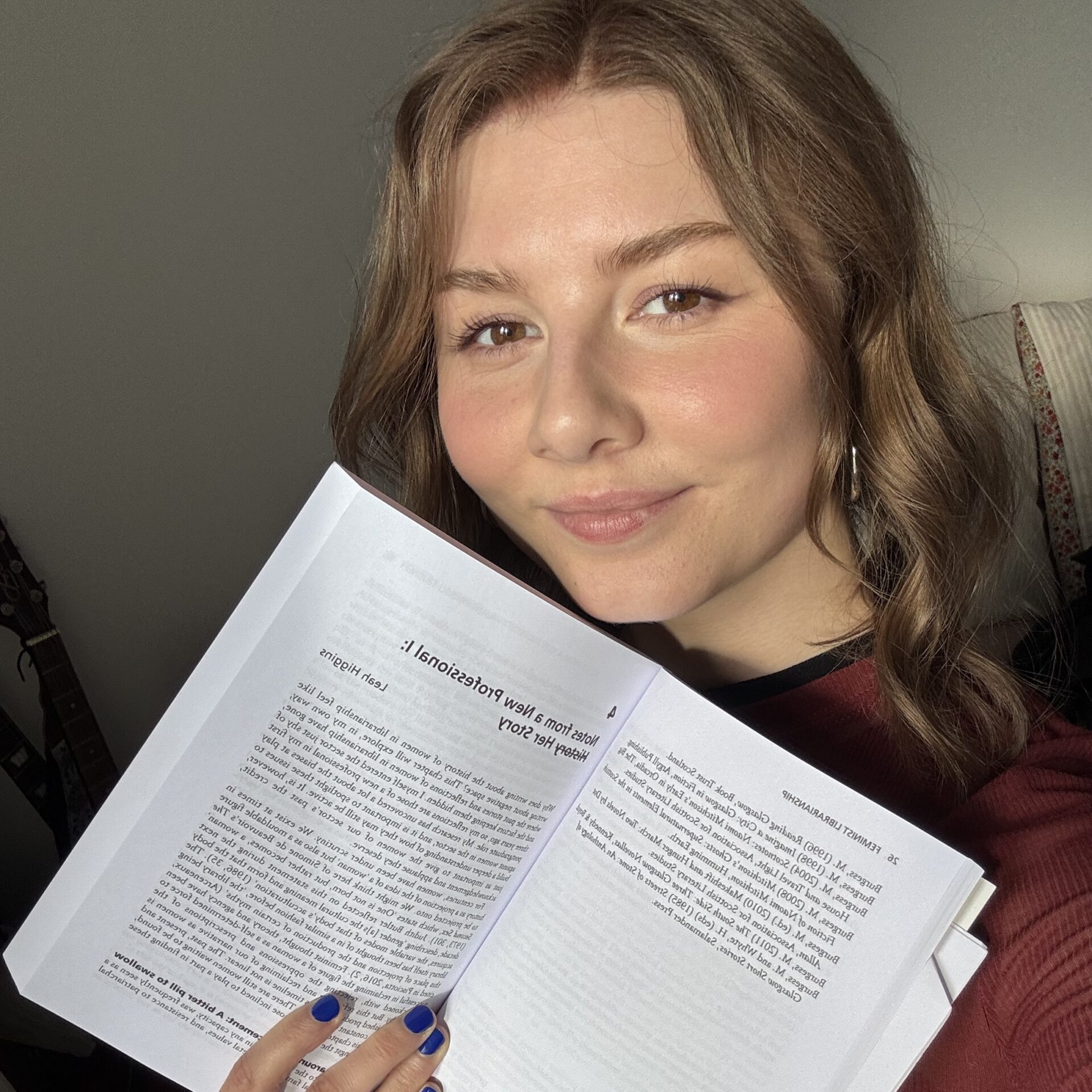
credibility is a huge part of information literacy. I’m Leah Higgins, and I currently work for the Chartered Institute of Library and Information Professionals in Scotland, and have delivered sessions on conspiracy theories and information literacy for information professionals and most recently my contributions to the sector have been published in the book Feminist Librarianship: Principles, Provocations and Practices. Convinced?
Libraries and librarians for centuries have been trusted spaces for democracy, conversations
and fact-based, evidence-informed information, in fact the IPSOS Mori polling routinely finds that Librarians fall in the top three most trusted professions in the UK. Conversely, Politicians routinely fall in the top five least trusted professions. However, systems and methods we once used to gather information, especially about important concepts such as politics, news and events have been complicated and fragmented by the rise of mis and dis information. Simply put, misinformation is incorrect information that is shared with good intentions, by someone who believes it to be true (think about a relative sharing fake health advice with you on facebook because they are worried it might impact you). Disinformation is false information which is shared with the intention to deceive someone, usually to proliferate a specific negative idea against someone or something (think about a smear campaign against a political candidate for example, it’s being done from one end to persuade political gain on the other).
Thinking more specifically about how this impacts young women, especially in the year of
something like a national election, it’s crucial to ensure that we have all the facts in order to
make autonomous decisions and hold our elected individuals to account. Another dimension to this story, if we take the 2026 national election as an example, is how female politicians, young women and transgender women are targeted online by fake profiles, targeted hate groups, online users and the press. In 2025, Holyrood surveyed 22 female MSPs and at least half of this sample said they had experienced targeted disinformation, the nature of these attacks are pointedly misogynistic and intentionally gendered. A year on from this report, we have already seen a high volume of targeted attacks on the women sworn into our new cabinets. Highlighting the very real fact that mis/disinformation, trolls and false artificially generated content can interfere with any point in the political calendar, we need to be on high alert and robust against false information sharing, especially the kind that targets minority groups. The very real threat that comes from mis/disinformation is that young women will be discouraged from engaging in politics. We are already on the defense with our own personal wellbeing when it comes to navigating the online world. Why would young women put themselves forward when they know this is almost an expectation of the job? Importantly, the information in this blog is intended for young women, but it is also essential reading for our allies, and those with integrity invested in sharing truthful, evidence-based information. This problem is not for young women to solve, especially when we are so often the ones most impacted by it.
As young women navigating the world, we have an interesting relationship with trust. We
have to trust ourselves even when other systems and people don’t. But what role does trust
play when it comes to information exchange, and how is this complicated in a media
landscape which is increasingly designed to overwhelm and mislead us? Thankfully
organisations like the Young Women’s Movement exist to magnify our experiences, and
create resources like ‘A young women’s guide to misinformation’ developed by the Young
Women Demand steering group to support democratic participation.
Looking at this excellent resource, compiled by young women, for young women, what
practical tactics can we deploy to create a more robust defence to mis/disinformation online?
Emotions can be really powerful, and that’s why often bad actors use inflammatory tactics
and phrases or figures that create heightened emotional impact, often used as a distraction
tactic to make you react quickly. Especially online, any engagement with misinformation is
problematic, no matter your intention because the algorithm pushes it regardless of whether it was a positive or negative reaction. If we look at step 1 of the guide we will see that ironically enough, being emotionally attune with your gut is also the way to combat this type of misinformation. You should let these instincts guide you by trusting your gut feeling – if something sounds preposterous then it probably is OR you shouldn’t believe it until you have hard proof.
Sharing what you believe and speaking about causes important to you is a fantastic way to
engage with your peers and create a sense of who you are. Most importantly however,
remember nothing that you share online has to be done immediately – sharing it 5 minutes
later won’t lessen the impact of anything you share but it could be the difference between
sharing something misleading and sharing something true. Misinformation and conspiracy
theories thrive under pressure with highly emotive content, so don’t let the information
overwhelm create a false sense of urgency.
What I’ve discovered since researching this topic is that perhaps unsurprisingly, the reason
that people gravitate towards mis/disinformation is because it scratches a certain itch in our brain. Our brains are used to filtering and collecting information, and mostly relying on its accuracy, making connections between pieces of information. If we see something
presented to us by a media outlet, shared by a friend/family member, or in an infographic
format we’ll automatically give it a degree of credibility. One possible reason is a
phenomenon called Pareidolia, the best way to describe this is through example:
Look up into the sky at the clouds, now I’ll ask you to not find anything in the clouds, don’t let your brain make out any shapes or animals etc- it’s pretty difficult right?
Pareidolia is the phenomenon where our brains see faces and recognisable shapes within
other things, similar to the ink blot test. So at times information, when shared a specific way, relates to this part of our brain, which seeks to find answers, connect facts and explain
information. Social media churns out so much information accredited to anyone with a
phone, so the chains of connection which once served us accurate information, can no
longer contend with the amount of false information we’re accustomed to seeing.
We have a running joke in my friend group that, to their great annoyance, I always try to play
devil’s advocate, seeing both sides of any story in order to understand the full picture. The
YWM’s guide outlines a similar tactic which is actually very helpful in this scenario. Step 2 is
to ‘leave the echo chamber,’ and challenge yourself or the belief that you hold. Make it a
challenge to prove yourself wrong, and if you can’t then you can probably and safely assume
you are correct. And who doesn’t love being right?
Step 3 in the guide maintains that you should check with a trusted source. Below, I’ve shared some handy acronyms to help you consider all the different angles that might relate to a piece of information and its purpose. Helpful fact checking charities like Full Fact for the UK and in Scotland, The Ferret Fact Service are also fantastic and easy to use resources for on the go.
In the library sector, we love an acronym so why not SIFT through the CRAAP? Here’s two
acronyms, widely used in the library and information sector that you can use to decide
whether you should share information online or not:
The SIFT Method, created by Mike Caulfield is mostly helpful in deciding whether or not to
share resources or information you’ve found when scrolling social media:
S is for… Stop – again nothing will be so time sensitive that it can’t wait a few minutes to run through the rest of the steps. In fact if it is being presented as time sensitive then there’s even more of a reason to be suspicious of the information.
I is for… Investigate the source – have a look at who wrote or published it, are they a well
respected voice in that field, do they have qualifications to back up what they’re saying?
F is for… Find better coverage – are multiple verified and established sources saying the
same thing as the initial source you encountered? If so then you’re probably safe.
T is for… Trace the claim to its original context – some stories can be victim to a game of
telephone, being further embellished the more they’re shared. If you can find the original
source, video, audio etc then you can better understand the context and why someone might have shared the piece of information. You might decide that the original source is biased or spreading disinformation, in which case tracing it back can help you make an informed choice.
The CRAAP test is better used when you are researching a specific topic or perhaps looking
for an answer to a question:
C is for… Currency – is the information you’ve found the most up to date version, have the
research or findings moved on since this source? An easy way to spot this is broken or
outdated hyperlinks. Certain things may have been debunked since, so it’s always worth
checking.
R is for… Relevance – consider whether the source actually answers the question you’ve
asked, don’t make information fit just for the sake of convenience.
A is for… Authority – as above, consider the author’s qualifications and more importantly
reasons for writing this article/research/post. Have they been sponsored or are they affiliated with a person, group or organisation which might impede their ability to be unbiased?
A is for… Accuracy – Has the information been clearly sourced or cited, have others with
credible backgrounds peer reviewed the source? Are there other pieces of evidence that
corroborate what the source is finding?
P is for… Purpose – think about what purpose this information is serving, why does it exist?
Is it there to support an agenda or do the findings of an unbiased piece of research come to
a natural conclusion about the topic? You can usually come to this conclusion clearly by
following the steps above.
Now that you’ve SIFTed through the CRAAP and established if the source is credible or
unreliable, you can make an informed choice about whether or not to share the information.
The more times that you follow these steps the more ingrained it becomes in your
information seeking and sharing behaviour, and you can move forward with confidence in
what you choose to share.
It can feel wholly overwhelming at times, and you might not always get it right, but the
important thing is that you try your best to do your due diligence. If young women are given
the choices, resources and information to learn how to harness information effectively, they
can be the antidote to so much of the poison we see shared online. They can be the ones
disseminating the information which truly reflects their experiences, and furthers interest and research on issues that disproportionately impact young women. They can function with an immediate confidence which in turn might influence a positive wave of information,
successfully mirroring young women’s experiences, allowing them to more fluently function
in democratic society.


(she/her), 26, from Glasgow
Leah Higgins is currently the Digital Officer at the Chartered Institute of Library and Information Professionals in Scotland. She holds an MA in History of Art from the University of Glasgow and a HNC in Media and Journalism from City of Glasgow College.
In 2017, she organised the Women’s March for Scotland at age 16. This protest saw over 5,000 supporters create a united and public front against misogyny in Scotland. In 2025 Leah was named as one of the Young Women’s Movement 30 Under 30 in Scotland. The following year, Leah authored two chapters and an accompanying podcast for the Book Feminist Librarianship: Principles, Practices and Provocations (Facet), as well as acting as the New Professional Advisor for the text.
Read our Young Women’s Movement Response to the Programme for Government 2026-2031!
So, with 30 Under 30 nominations being currently open, it felt like the right time to talk about what recognition actually does for young women. Not in abstract terms, but in real ones.
In this article, Young Women Remember researcher Katie Fielding explains what Oral History is, and how it has shaped the Young Women Remember digital archive.
Iona worked on our Young Women Remember digital archive project – read about her experience as a researcher.