In this article, guest blogger Gabrielle shares the stories of queer Scottish women largely forgotten by history.
Scotland’s rich tapestry of queer history has for a long time remained underrepresented and unspoken. This unspoken queerness of Scottish history is particularly evident when it comes to investigating the lives and loves of women. Through history, women are often forgotten, despite pioneering new ideas within the fields of medicine and art. For these women in particular, a key part of their story often remains untold: the women they loved. Their rich lived experiences as queer women covered up with a simple sentence in biographies and on Wikipedia: “she died unmarried”.
While not all of these Scottish women openly identified as lesbian, there is an understanding among contemporary academics that they had romantic relationships with other women. Relationships which are still described as “intimate friendships”, and partners as “colleagues” or “companions.” Writers cautiously skirt around the evidence which suggested women wrote love letters to each other, lived and worked together, socialised with other openly lesbian women, or considered themselves married to their partners long before gay marriage was legalised in the UK in 2014. This Pride month, we want to address and celebrate the unspoken queerness of Scottish women who formed a crucial part of Scottish history from the end of the 19th to early 20th century.
It is important to recognise that while these women suffered societal misogyny and homophobia, and their lives and loves have often been all but dismissed, they still only illustrate a small slice of Scotland at the end of the 1800s and beginning of the 1900s. These were women who had wealth and connections, had freedom to travel, had access to a good education, and benefitted from or had direct ties to the British Empire. They led unusually privileged lives, but to understand our history we need to uncover what stories we can, and openly talk about the fascinating people that modern queer culture in Scotland is built on. Victorian women, while frequently happy to be seen living in “romantic friendships” of varying intimacy and companionship, often attempted to hide or disguise their own lesbian desire and the nature of their romantic relationships, as Terry Castle writes, in the Western imagination same-sex female desire exists “as an absence […] a kind of love that by definition cannot exist”, as female homosexuality was never explicitly targeted with any legislation.
The queer history of Scotland has for many years remained unspoken and brushed under the carpet. ow their lives are being reinvestigated we can see that queer women have always existed in Scotland and have formed key parts of our history, from establishing hospitals, leading archaeological excavations, fighting for women’s suffrage or being involved in artistic movements. As Martha Vicinus writes, lesbians and female homosexual sexuality “repeatedly evaporated into denial, concealment or displacement, but it also never disappeared.”
Flora Murray (1869-1923)
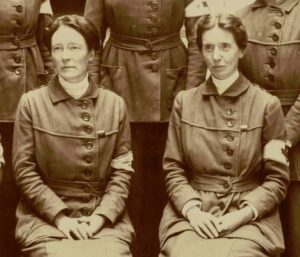
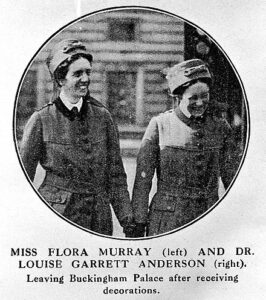
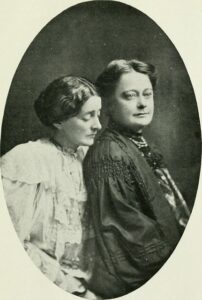
Ground-breaking medical pioneer and suffragette Flora Murray was born in Dalton, Dumfriesshire in 1869, but her life and legacy are celebrated widely across Scotland and the rest of the UK today, with her portrait featuring on the new Bank of Scotland £100 note. On her gravestone she and her long-term partner, the surgeon Louisa Garrett Anderson (1873-1943), are remembered with the epitaph “we have been gloriously happy.” Raised in Scotland, Murray was a physician who specialised in anaesthesiology, having studied medicine at the London School of Medicine for Women, Durham University and Cambridge University, receiving her MD in 1905.
Both Murray and Anderson were dedicated to the Suffragette cause, meeting during the fight for women’s votes. Anderson, an English surgeon who studied in Scotland, the niece of Millicent Fawcett and daughter of the first female doctor in Britain, was heavily involved in the protests, even being jailed for her part in the movement.
While she was not imprisoned for her activism like her partner, Murray also played a crucial part in the movement as their ‘honorary doctor’ using her medical skills to treat suffragettes who had been force fed during hunger strikes. The anger about women’s positions in society must have been felt keenly for Murray and Anderson, as they faced discrimination in the medical field. Before the outbreak of World War One, female medical practitioners were banned from treating male patients, relegated to paediatrics and women’s health.
The couple are remembered as medical trailblazers, pioneering a route for female doctors into mainstream hospitals. In 1912 they founded the Women’s Hospital for Children together. When war broke out in Europe two years later, Murray and Anderson founded the Women’s Hospital Corps. Staffed entirely by women, their team worked with the French Red Cross in Paris until 1915 when the British government requested that they return to London to run the Endel Street Military Hospital in Covent Garden. The couple ran and treated patients in the military hospital until 1919, treating nearly 24,000 wounded and traumatised soldiers, as well as dealing with the devastation of the 1918 Spanish Flu pandemic. One patient, a soldier, described the hospital as “one of the best […] in London”, however after the war their pioneering efforts were forgotten, female doctors and medical practitioners once again being pushed away from mainstream hospitals.
The couple lived as if they were married, allegedly wearing matching diamond rings, and retired to their jointly owned cottage in Paul End, Penn, Buckinghamshire in 1921 where they lived together until Murray’s death from cancer in 1923. Murray left everything to her partner in her will and dedicated her 1920 memoir Women as Army Surgeons to Anderson “my loving companion”.
Today Flora Murray is celebrated in Scotland for breaking boundaries in the field of medicine. However, her queerness has for a long time remained brushed aside, a minor footnote in her life as a medical pioneer, which is why we now want to shed light on her life as a queer woman this pride month.
However not all of the pioneering queer Scottish women of this period are so well known or as celebrated as Flora Murray, in fact very little has ever been written about Janet Gourley…
Janet ‘Nettie’ Gourley (1863–1912)
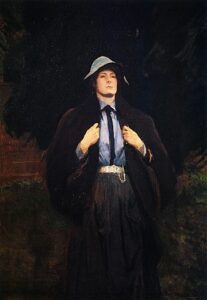
Women’s work has often been all but erased from history, due to the inherent biases of the men who write such history. Queer Scottish Egyptologist Janet Gourley is no exception, her work relegated mostly to a footnote in a ‘who’s who’ of archeology, despite her pioneering archaeology remaining a crucial aspect of the study of ancient Egypt. Gourley paved the way for female archaeologists in Britain when she co-directed two seasons of excavations at the Precinct of Mut, Egypt, from 1896, alongside her partner, the celebrated writer, philosopher, and Egyptologist Margaret “Maggie” Benson.
Gourley was born in 1863 and raised in Dundee, Scotland, and went on to study at the University College London alongside celebrated archaeologists William Flinders Petrie and Margaret Murray. In 1896 Gourley was introduced to Benson by a mutual friend, Lady Jane Lindsay, while staying at the Luxor Hotel, where they quickly formed a working and likely a romantic relationship. Gourley had the academic experience needed to aid Benson in the latter’s passion project of excavating the Precinct of Mut, an ancient Egyptian Temple complex, the second season of which was the first female led excavation in Egypt, as they write in the preface of their report on the excavations they had “the first permission to excavate given to women in Egypt”.
Working together allowed the women to act independently of men in the field, and the couple continued for two seasons of excavations before Benson’s health declined and they returned to Britain. One of their most significant discoveries was a statue known as The Benson Head, which is now held in the British Museum. They planned to return to Egypt to continue excavations but due to Benson’s health never did. However, the couple co-authored a book on their excavation and findings at the Mut Precinct, which in 1899, became the first book on Egyptology by women to be published. Gourley went on to co-author a journal article with Percy Newberry in 1901, on the Mut excavations.
While historians continue to gloss over the romantic nature of Gourley and Benson’s relationship, describing them as “companions” “friends” and as “dying unmarried”, their own words consolidate their affection for each other. In one letter to Gourley, Benson wrote that she had been “dreaming of you” and later the same month wrote “I wish I knew the Gaelic language, for I believe you are able to say all sorts of affectionate things in it which English can’t express. I do want you in bodily presence very badly, my dearest.” Gourley’s partner was known to have “intense” relationships with women, and according to some historians Benson, her mother and two of her brothers were also likely queer. It is understood that in their circles it was well-known that the women were in a romantic relationship, a letter from Lindsay to Benson’s mother suggests Benson, who suffered from mental health issues, was “so full of vigour” and in “high spirits” in the company of Gourley. The two continued affectionate and frequent correspondence until Gourley’s death in 1912.
Women in lesbian relationships could find themselves with more freedom than some of their peers, given the economic independence and freedom to travel and work as “companions” meant that these queer women at the turn of the century were able to develop both romantic and working relationships outside of the sphere of men. This working relationship can also be seen in the life of Kit Anstruther Thomson and her partner Vernon Lee.
Clementina ‘Kit’ Anstruther-Thomson (1857–1921)
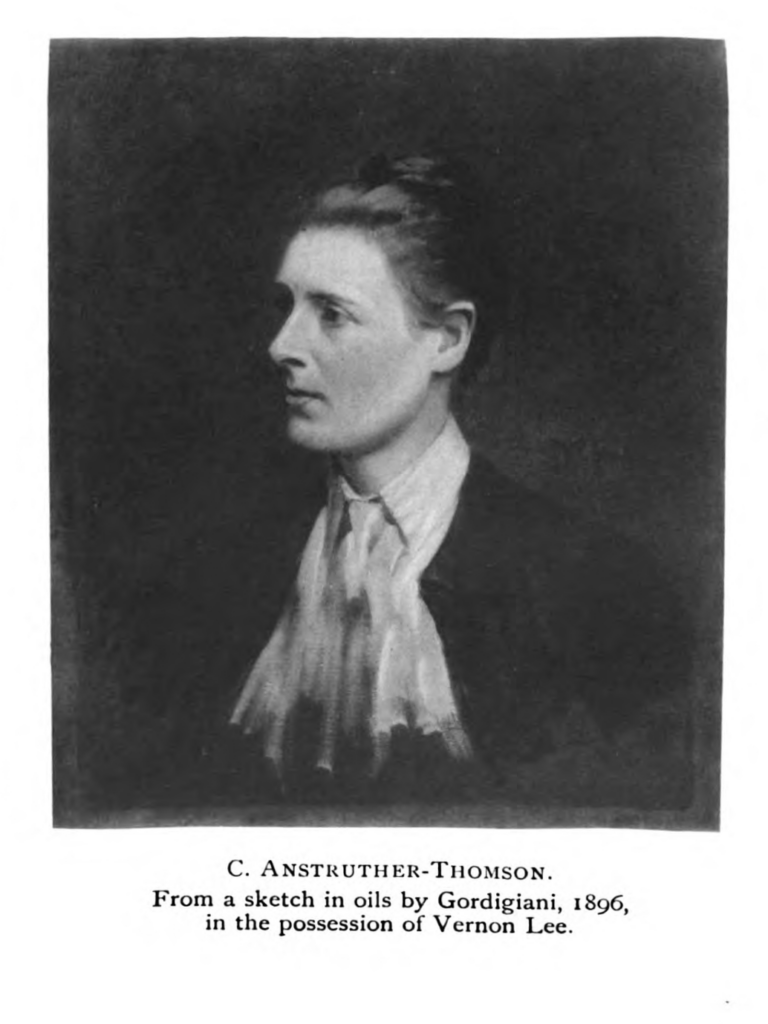
The Scottish artist, art historian, theorist and writer Clementina ‘Kit’ Anstruther-Thomson lived openly as a lesbian in a long-term relationship with the essayist Violet Paget, also known as Vernon Lee, in Florence, Italy. Born in Edinburgh to a Scottish aristocratic family, Anstruther-Thomson studied at the Royal College of Art and Slade School of Art, becoming an art historian and theorist. Anstruther-Thomson is also remembered for her dedication to social reform, such as her support for the Bryant & May matchgirl strikes, and for her Humanist beliefs, as a member of the West London Ethical Society.
Described by friends and acquaintances as “witty” and statuesque, and likened to the Venus de Milo statue, Paget writes that she was already enamoured with Anstruther-Thomson before they met and fell in love in the summer of 1887. Anstruther-Thomson, the lover, muse and collaborator of Paget, was later described by her partner as a “goddess among goddesses”. The couple travelled around Europe, Anstruther-Thomson using her wealth and connections to tour private galleries across the continent. She was interested in classical art, from ancient Greece and Rome.
Paget and Anstruther-Thomson also worked together, publishing their seminal text on the psychological aesthetics ‘Beauty and Ugliness’ in 1897, which theorised individuals could have involuntary physical and psychological responses to visual stimuli such as artworks, creating an empathy with, attraction to, or revulsion of certain artistic works. Their contributions to the Victorian aestheticism movement is a key part of British art history, and as Hilary Fraser suggests, the couple’s pioneering work “made room for multiple versions of spectatorship, and so empowered women’s looking”.
The couple leased a villa in Florence and lived there together from 1888 until 1898, when Anstruther-Thomson left Paget, after suffering from a decline in her mental health, and returned to Britain. Although separated, the two remained close until Anstruther-Thomson’s death in London in 1921. Paget compiled her papers into the posthumously published Art and Man, which details Anstruther-Thomson’s life, ideas and work.
Within the world of art queer voices have often remained distinct, not fully brushed aside by historians, and partnerships such as Anstruther-Thomson and Paget have been well recorded in their own work and in the work and correspondence of their peers. The relationship between sculptor Harriet Hosmer and art collector Louisa Baring, Lady Ashburton, is similarly remembered by the artistic circles of their era.
Louisa Caroline Baring, Lady Ashburton nee Stewart-MacKenzie (1827-1903)
Another key figure in the Scottish art world of the late 19th to early 20th century was the art collector and philanthropist Louisa Baring, Lady Ashburton. Baring is known to have been romantically involved with both women and men during her lifetime, including liaisons with prominent Victorian creatives Harriet Hosmer and Robert Browning.
Born in 1827 on the Isle of Lewis, to a Scottish aristocratic family, Baring’s childhood involved a lot of travel. Her early years were spent in Brahan Castle, Dingwall, before her family moved to Sri Lanka, and then Corfu, before finally returning to Scotland in 1843 after the death of her father. While Baring is remembered primarily as an art collector, socialite, and philanthropist she also studied drawing under the tutelage of John Ruskin. Baring rejected the advances of various eligible men from the art and literary circles of Britain, such as Edward Landseer, and married Lord Bingham Baring Ashburton in 1858. They were married for six years, until Lord Ashburton’s death in 1864. They had a daughter, Mary ‘Maysie’ Florence, named after Florence Nightingale, the innovative British nurse and statistician. Nightingale, who is sometimes considered to have been queer herself, was part of Baring’s close social circles which included great Victorian thinkers, innovators, and artists. Baring was described by her peers as an energetic, sometimes abrasive, romantic who was “socially ambitious” befriending and patronising artists, as one contemporary wrote, “bevies of impecunious artists hovered about her like locusts”.
Three years after the death of her husband Baring met the celebrated American sculptor Harriet ‘Hatty’ Hosmer (1830-1908), in the artist’s studio in the spring of 1867. They became close quickly, and a year later, during a trip abroad together, their friendship became a romance. Baring acted as both a patron and lover to Hosmer, who is known as the first female professional sculptor, providing the artist with a studio near her home in Knightsbridge, and using her socialite connections to create a community of artists around them. Hosmer was known to be lesbian, and is described by Vivien Green Fryd as “unconventional […] energetic and boyish”. Hosmer referred to Baring as her “wedded wife” and their letters record their desires eloquently as lovers, such as one in which Hosmer wrote “what I would not do to have you in my arms to kiss you and tell you how dearly I love you”.
However, their passionate 25-year relationship was complicated by affairs, and they rarely lived together. Unlike some of her other more socially reserved romances with women, such as a probable fling with her daughter’s tutor, Baring’s relationship with Hosmer was essentially ‘outedoutted’ to their wider social circles by Hosmer, when she ‘improperly’ spoke out against Robert Browning’s advances towards Baring.
Baring died in London from cancer in 1903. She is buried in Garve, Highland. After her death most of her art collection had been sold, and no inventory of it ever resurfaced, however it is known she had collected many important artworks by artists such as Rubens, Rossetti, Titian and of course, Hosmer.
Across different fields of expertise, from medicine, to history, to art, queer Scottish women have been an integral part of constructing our world, whether through fighting against injustices, pioneering routes for women into fields they were previously barred from, or being creatives, furthering our understanding of and access to art. These women, and their partners, are just a small slice of the lives of queer women in the late 1800s and early 1900s in Scotland, but their influence continues today; in our hospitals, in our universities, and in our daily lives. We mustn’t take for granted their contributions to our Scotland, but rather we must continue to open up the conversation, celebrating these women and their queerness, for who they were, paving a path into the future where all young women learn about their queer Scottish fore-mothers.