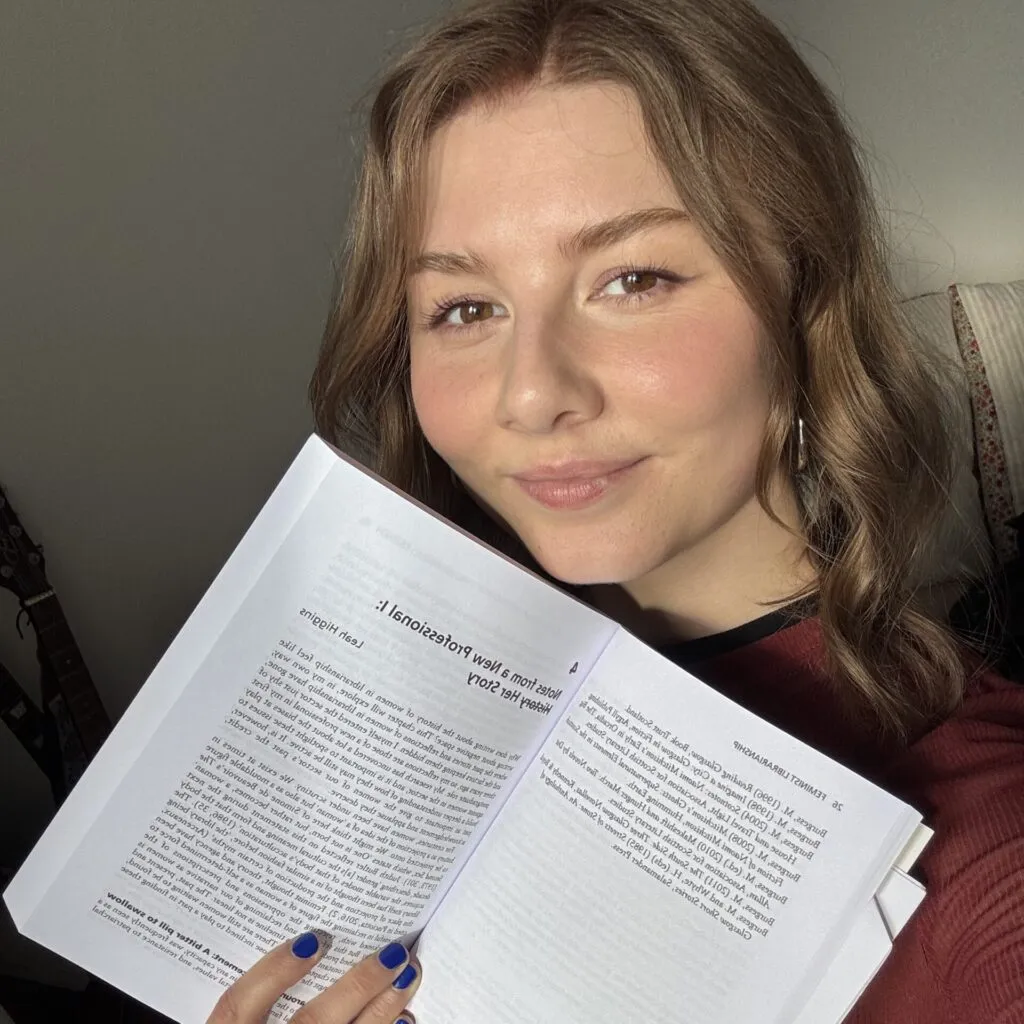
Do you need help SIFTing through the CRAAP post Scottish Election? Let a local feminist library professional help you!
- Education
- Online safety
- Top tips
- Article
Estimated reading time: 5 minutes
In this article, Matilda reflects on the world young women want to see, and how we can shape the headlines of tomorrow.
Trigger warning: Mentions of VAWG, misogyny and racism.
Hope has become an increasingly radical form of resistance for young women where despair is dominating the news headlines. As blatant misogyny gets louder in both the digital and physical worlds we exist within, collective optimism for our rights decreases in volume.
While noise-cancelling headphones become ever more tempting, remember you are not alone. If you’re among the 64% of young women who feel overwhelmed by news of global events, I invite you to wonder: what would the headlines look like in a feminist future? Media that excites us not exhausts us, notifications that don’t leave us nauseated. Whether you’re a paper reader or a social media reel-er, join me in imagining patriarchy-free print.
Until those headlines arrive, I’ll share some feminist wellbeing practices to tend to yourself and the collective to keep up the hope and put the change we crave into circulation.
Headlines of 2025 have featured relentless rollbacks of the rights of intersectional women and other marginalised communities across the globe. Whether you actively seek out daily news, or have been passively informed by algorithms, you’re likely to have consumed something that has put the security of rights for young women into question. From rising reports of violence against women and girls, to weaponisation of women’s safety to spread racism, to regressive political shifts and oh, how could I forget – the manosphere.
Considering this, it is unsurprising to see that Gen Z women are the most affected by global news and events. Studies indicate both heightened empathetic engagement with media and greater disparities in mental ill-health among girls and young women.
Remaining aware of the issues and remaining able to imagine a world where they no longer exist has become an increasingly exhausting ask. Re-writing the headlines is going to require our energy and ambition. Not only that, but a radical hope for change.
I recently learnt the word “radical” comes from the Latin word “root”. Ever since, I’ve placed an emphasis on viewing hope as radical in the current context. Each step towards a more gender-equitable future that has come before us has been made by a person who was rooted in their hope for change. Change that may have felt realistically impossible but radically a powerful possibility.
Think back to 2020, where headlines of hope for a feminist future in Scotland were delivered through the legislative requirement for free period products. While there is still drastic progress to be made when it comes to women’s health equity, there is no doubt this instilled hope in many women. Since then, it would feel like a victory for the media to use a woman’s name as opposed to her gender-identity – or worse, her husband’s.
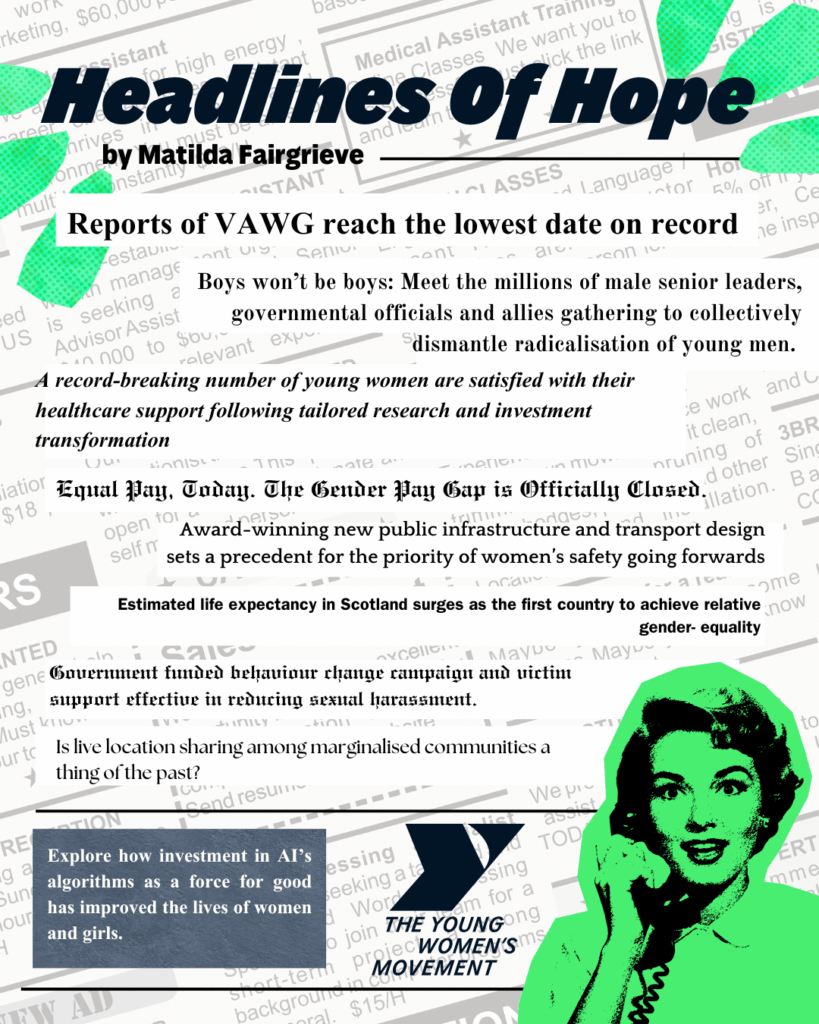
Until we see articles that meet our ambitions, take a look at the image below to consider what the headlines could look like in a better Scotland. Remain rooted in such hope and perhaps we can grow trees to print tomorrow’s newspapers from, patriarchy-free.
1) Connection with your community.
While we’ve acknowledged that a sense of overwhelm due to the news right now is collectively felt by young women, it can be an isolating feeling. Loneliness is widespread among young people right now. Yet the need for social connection acts in the same way as hunger and thirst in our brains. Nurture your wellbeing by looking for ways to connect with the community wherever possible.
Access to community looks different for each individual but often starts by seeking out people who share similar values. Places where passions are paired are powerful, digital or physical. There is hope in those moments of connection. And while we’re being radical, if you’ve struggled to find a community that aligns to your niche, use our ever-connected world to your advantage…create it!
Why not gather with like-minded individuals and create your own headlines of hope?
2) Tending to you: remember the origins of radical.
I don’t know who needs to hear this, but if you have found your mental health to be negatively impacted by the news, give yourself permission to take a break when you need it. You must take care of yourself to have hope for the future with your healthy self within it. Take a moment to do something that nourishes your mind and allows you to ground back into yourself.
Remember the origin of the word radical? Radical is to be rooted, so if that involves some radical self-care in this current context make sure you do so. A version of you reading the headlines of a feminist future will thank you.


Matilda Fairgrieve is an Inclusion and Wellbeing Campaigns Officer focused on ensuring businesses and informed and equipped to prioritise gender equality at work.
Outside of her current employment, Matilda thrives when leaning into her curiosity for creative activism, most recently through writing. Intersectional feminism is a unwavering passion for Matilda, who looks forward to continuing to connect with other diverse women on the issues impacting our today and tomorrow. Always keeping up the hope for a gender-equitable future- together! Find Matilda on LinkedIn and Substack.
Do you need help SIFTing through the CRAAP post Scottish Election? Let a local feminist library professional help you!
So, with 30 Under 30 nominations being currently open, it felt like the right time to talk about what recognition actually does for young women. Not in abstract terms, but in real ones.
In this article, Young Women Remember researcher Katie Fielding explains what Oral History is, and how it has shaped the Young Women Remember digital archive.
Iona worked on our Young Women Remember digital archive project – read about her experience as a researcher.