A young women’s guide to misinformation
A young women’s guide to misinformation
This resource was developed by the Young Women Demand steering group to support democratic participation ahead of the Scottish 2026 election.
Published on:
- Information
- Online safety
As the Scottish Parliamentary Election on 7 May draws closer, there is growing concern amongst researchers, politicians and election officials on the impact of misinformation and ‘fake news’ being spread online, purposefully designed to fool and influence voters (The Ferret, 2025; RSE, 2025). The digital landscape is particularly hostile for young women and girls, whose anxiety regarding false or misleading information is notably high. Recent research from SYP and Young Scot (Young People & Politics, 2026) found that 65.7% of girls and young women in Scotland aged between 11-25 find it hard to know what is true or fake online when it comes to politics, compared with 50.7% of young men. The rampant spread of political misinformation online presents a significant threat to young women and girls’ engagement in democracy as it accelerates their distrust in the current political system and further fuels a feeling of political disconnect.
It is not surprising that online misinformation has been found to be deeply gendered, specifically targeting women and gender nonconforming persons as a strategy to silence their voices, undermine their leadership and ultimately prevent women and gender minorities from further political participation (UN Special Rapporteur on Freedom of Expression, 2023; Gehrke and Amit-Danhi, 2025). In an online environment where misinformation thrives and digital violence against young women and girls is met with systemic impunity, it is no wonder that young women cite the threat of sexualised and misogynistic abuse and a resulting lack of representation as key barriers to their democratic engagement.
At The Young Women’s Movement, we are deeply concerned about the rise of online misinformation – not only because it exposes young women to online violence, but because it acts as a fundamental barrier to young women and girls exercising their right to democracy. To combat this, the Young Women Demand steering group have created this guide to help young women and girls navigate the digital landscape during the Scottish Parliamentary Election and beyond.
This guide contains essential information on spotting misinformation and practical tips for challenging it. We believe that knowledge is power. By equipping ourselves with the skills and expertise to deconstruct false narratives, we sharpen our critical thinking and ensure that young women are empowered to lead, participate and demand change.
What is misinformation and disinformation?
The term ‘fake news’ has become a household phrase, used to refer to false or misleading content spread online. However, experts and parliamentarians have raised serious concerns about how this term is being increasingly weaponised to discredit valid information and shut down conversation, leading to widespread confusion over what is actually true. For this reason, it is more accurate to talk about misinformation and disinformation as defined by Ofcom, who are the independent regulator responsible for online safety in the UK
- Misinformation: False or inaccurate information shared by mistake with no intent to cause harm. (e.g. sharing a rumour or inaccurate photo online that you believe is true)
- Disinformation: False information created and shared deliberately to deceive,whether to cause harm, or for political, personal or financial gain. (e.g. a campaign deliberately spreading lies about a political candidate)
Understanding the different types of false information that we see online is key to knowing exactly what to look for and feeling confident in what we believe to be truth.
Note: For the purpose of this guide, we use “misinformation” as an umbrella term referring to all types of false or misleading information.
What does misinformation look like?
A lot of the misinformation that we see online isn’t always a total lie, it often contains a grain of truth that has been twisted to deceive you. Here are the most common forms of misinformation:
Satire or parody
Content that uses irony or exaggeration for comedic effect. There is usually no intention to cause harm, but it has the potential to fool someone who doesn’t recognise the joke. E.g. The Daily Mash articles
How to spot? Check the account’s bio. Satire accounts usually state parody or satire in their description.
False connection
When the headline, visuals or captions don’t support the actual content of the story. E.g. ‘clickbait’ headlines
How to spot? Read the whole article before sharing. Does it actually provide the “shocker” promised in the title?
Misleading content
Using information to frame an issue or person in a misleading way, often by selectively cropping out facts or context.
How to spot? Search for the full video or article.
False context
Sharing genuine photos or videos but claiming they are from a different time or place.
How to spot? Reverse image search e.g. Google Lens will show you when and where the image first appeared on the internet.
Imposter content
Accounts or websites that impersonate reliable sources, such as using a recognised organisation’s logo or name to gain trust.
How to spot?
- Check the handle carefully for typos.
- Look for any official verification marks or check if the account was created very recently.
- Check the website URL matches the official website exactly.
Manipulated content
Real imagery or audio that has been doctored, cropped or edited to change the story or person’s appearance. This includes AI-generated ‘deepfake’ videos, which are increasingly used to put words in people’s mouths.
How to spot?
- Look for glitches or blurry patches.
- Compare to original footage or photograph from a trusted news outlet.
Fabricated content
Any information, photos or videos that is 100% false and created specifically to deceive and do harm.
How to spot? If a huge story only exists on one random social media page and isn’t being reported by any other news or on the official government website.
Misinformation and the election
During elections, these different forms of misinformation are increasingly being used in an attempt to influence your belief, your opinions and ultimately: your vote. This is often driven by ‘engagement bait’ content deliberately designed to provoke a strong emotional reaction like anger or outrage and influence public narratives. While politicians have always used exaggerated and inflammatory claims to persuade voters, there is a key difference between campaign tactics and deliberate deception.
Below are some examples of how misinformation is deliberately being utilised ahead of elections in order to influence voters and to serve a certain political agenda or attack key political figures.
AI generated “deepfakes”
Convincing fake photos or video clips of politicians. In recent years, videos have been shared of Scottish politicians John Swinney and Maggie Chapman, making them appear to say things that they have not.
Fake social media accounts
Bot networks or “troll farms” post thousands of comments to create a false sense of consensus about a topic.
Astroturfing
Fake grassroots activity on social media which might look like adverts, pages and groups but is actually funded by untraceable donors with a political agenda. Investigations byThe Ferret have shown that anonymous groups spend thousands on Facebook ads to influence Scottish voters without ever revealing who they are.
AI chatbots (e.g. ChatGPT)
AI chatbots have been found to generate potentially misleading voting advice and promote misinformation around polling dates or misinterpret party manifestos.
The nature of the algorithm means that political manipulation, advertising and astroturfing are unfortunately all part of everyday social media. But it is worth remembering that behind every media outlet, social media account and platform, there are real people. Real individuals and organisations with their own interests, values and agendas that shape what they choose to publish, amplify or ignore. Understanding who is behind a source, and what they stand to gain, is just as important as checking whether the facts are accurate.
A note on media bias
TV and Radio channels like BBC Scotland, STV and local radio are legally required by Ofcom to be “fair and balanced” meaning that they must be impartial to different political views, especially during election periods. Unlike TV, newspapers like The Scottish Sun, The Daily Record, The Herald and The National are allowed to be openly biased and may endorse specific political parties or viewpoints. Social media platforms have no legal requirement for balance and their algorithms can create echo chambers, only showing you content that reinforces what you already believe, making it easier to forget that other perspectives exist.
This is why it can help to think about media sources in two distinct ways. Fact-checking services such as Full Fact or The Ferret are specifically designed to investigate and verify claims. Media outlets and commentators, on the other hand, report and analyse the news through a particular lens. Whilst this doesn’t automatically make them unreliable, it does mean that even the most reputable news outlet is shaped by the values and priorities of the people running it.
The most powerful thing you can do as a reader is ask: who made this, what do they believe and what are they trying to achieve?
How to feel confident identifying misinformation
When you see political content online, slow down & be curious.
Step 1: What’s your gut reaction?
Ask yourself:
- How does it make me feel? Does it make an extreme statement? If it feels like it’s trying to make you feel angry, sad or worried, it could be engagement bait.
- Is it playing on a trope? Does it rely on stereotypes or generalisations about a marginalised group? Misinformation often feels true because it targets existing societal prejudices.
- What’s missing? What is this post not telling me? Does a statement lack context?
Step 2: Leave the echo chamber
- Ask a trusted friend or family member – ideally someone whose news habits and opinions differ from your own: Does this look real to you?
- Challenge yourself: Be extra critical of posts that ‘prove you right’. We are most likely to believe a lie if it attacks someone or something we already dislike.
Step 3: Check with a trusted source or fact checker
- Ask yourself: Who posted it? Is it from a credible news outlet? If not, is the original source linked or cited? Look at other posts to check for partisan or biased content.
- Search for the specific claim, not just the topic. Look for verified sources and check whether credible news outlets are reporting the same thing. If it references specific laws or policy, find them!
- Use independent, non-partisan fact checkers
Where can I get reliable information?
Fact-checking services:
- Full Fact – The UK’s independent fact-checking charity. Checks claims made by politicians in the news and on social media. Their free toolkit also helps you to spot ‘bad information’ yourself.
- The Ferret Fact Service – Scotland’s only dedicated fact-checking service. Independently funded and transparent about its sources and process.
- BBC Verify – The BBC’s dedicated fact checking and verification team. Investigates viral claims, “deepfakes” and misleading content.
- Channel 4 FactCheck – Fact-checks claims made by UK politicians and in the media.
For reliable information about voting and the election:
- The Electoral Commission – The independent body responsible for overseeing elections in the UK. A reliable source for information on voter registration, polling dates and your rights as a voter. If you see anything online about voting that seems confusing or wrong, check here first.
- The Scottish Parliament – The primary source for accurate information on Scottish policy, legislation and how your representatives have voted. During an election, this is the place to check what parties have actually done, not just what they claim.
- Young Scot – Scotland’s national youth information and citizenship organisation. Provides reliable, accessible information specifically for young people on politics, voting and civic participation.
There are also many women-led political platforms and feminist media spaces that centre young women’s voices and experiences and exploring these can be a valuable complement to the sources above. As with any outlet, we encourage you to ask the same critical questions: who made this, what do they believe and what are they trying to achieve?
Tips for protecting your feminist wellbeing
Most of the time, misinformation is deliberately designed to make you feel anxious, angry,overwhelmed or silenced. For young women and girls, this is particularly intentional as research shows that online misinformation disproportionately targets women to provoke emotional reactions that undermine our confidence and discourage us from engaging in politics at all (UN Special Rapporteur on Freedom of Expression, 2023). Recognising this is an act of resistance in itself.
- Take breaks – Scrolling through political content, especially during an election, can be exhausting and distressing. Stepping away from social media is not disengagement, it’s self protection!
- Notice how content makes you feel – If a post leaves you feeling furious, hopeless or ashamed, pause before sharing. That emotional reaction may be exactly what it is designed to provoke.
- You are not responsible for ‘fixing’ the internet – It’s not your job to fact-check every post you see or to correct everyone who shares misinformation. Do what you can, protect your energy and know that using your vote is one of the most powerful things you can do.
- Find your community – combatting misinformation is easier when you do it together! Follow accounts and join spaces run by and for young women, that centre your experiences and share reliable political information.
Misinformation thrives when people feel too overwhelmed, too confused or too disconnected to engage. Every time you pause, check, question and share responsibly, you are pushing back against that. As young women, we demand accurate information, honest politics and a democracy that works for us.
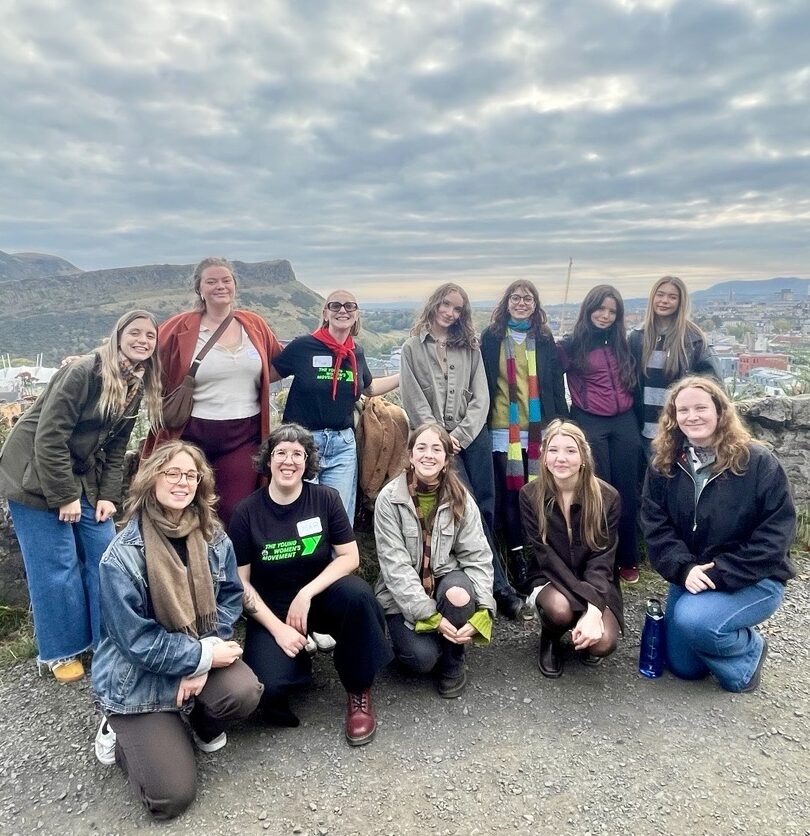


Young Women Demand is a programme to encourage young women’s democratic engagement, based on the findings of our Status of Young Women in Scotland 2024/25 and Young Women Lead 2024 research.
It is being led by a co-design group of young women and girls who will be campaigning for young women to exercise their voting rights in the 2026 Scottish election, as well as scrutinising party manifestos and explaining the electoral system in simple terms. Following the election, the group will scrutinise Government and opposition policies against their electoral promises.
Read the research behind Young Women Demand

Thank you to the Joseph Rowntree Charitable Trust for funding the Young Women Demand programme